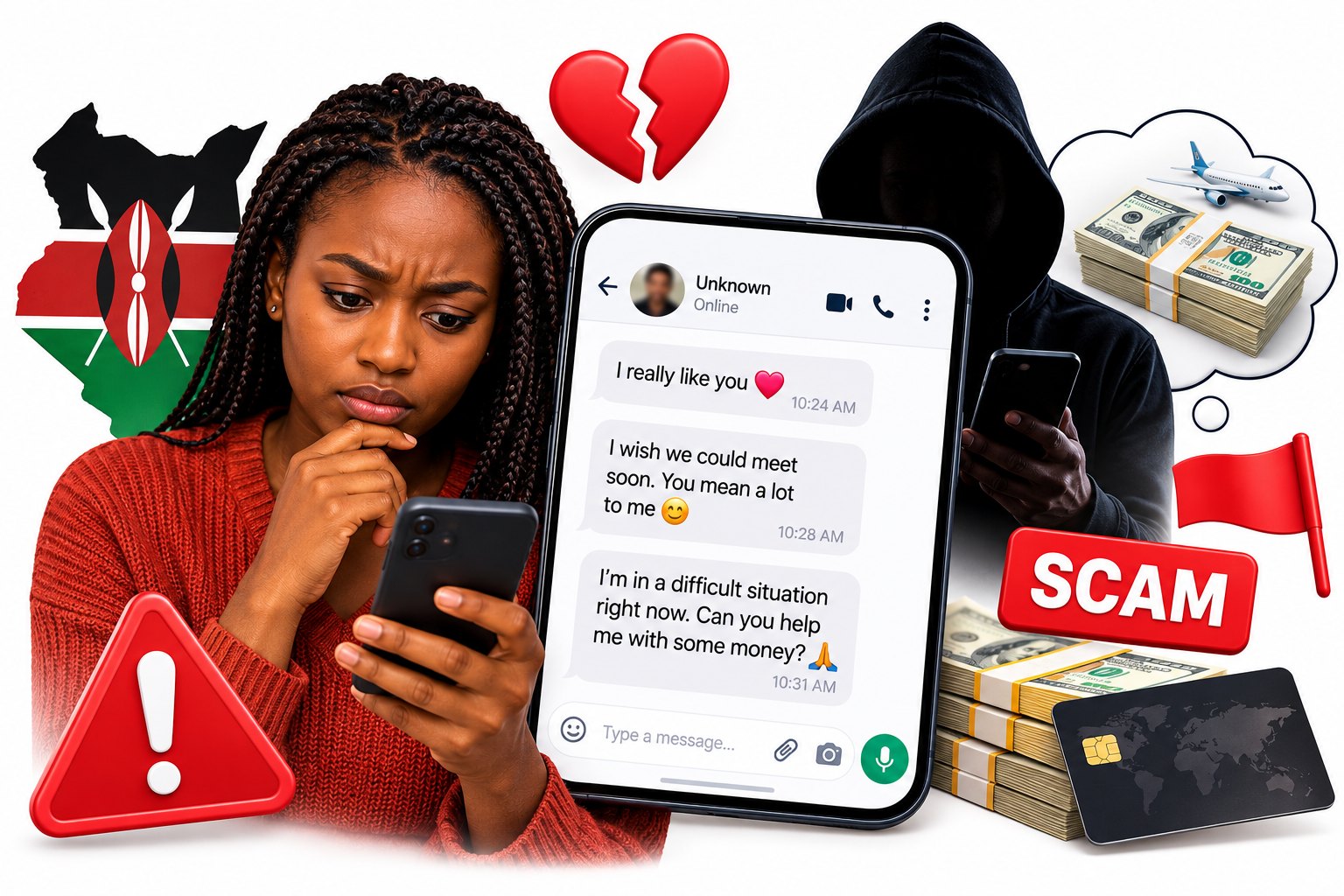


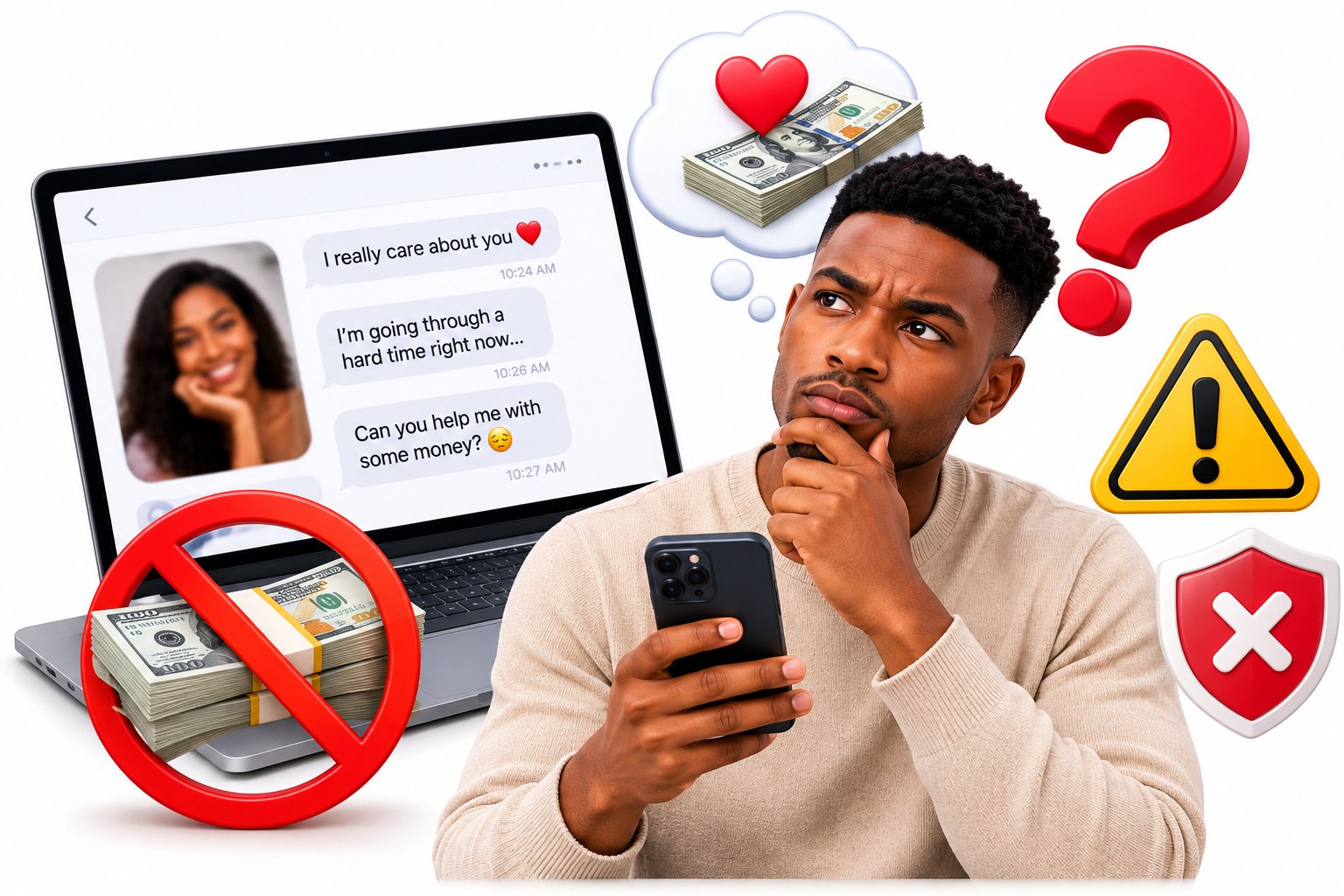
It usually begins gently. You have been chatting for a couple of weeks, you feel a connection, and then a message arrives: they are in trouble, and could you help, just this once? If you are wondering whether to send money to someone you met online, the short, honest answer is almost always no. This article explains why, how to tell a risky request from a normal one, and how to say no without guilt.
Saying no does not make you unkind. It makes you careful. A person who truly cares about you will respect that.
Why the answer is almost always no
When you have only known someone through a screen, you cannot confirm who they are, where they are or whether their story is true. Photos can be copied. Names can be invented. Even a warm voice on a call can belong to someone playing a role. Once you send money by M-Pesa, bank transfer or any other quick method, it is often very hard to get back.
There is also a pattern worth knowing. People who ask for money early in an online friendship often ask again. A small amount for airtime today becomes a hospital bill next week and a "business loan" the week after. The first yes makes the next request easier. For the full picture of how this plays out, read our guide to romance scams in Kenya.
Should you send money to someone you met online? Look at the request
Real life does include genuine emergencies, so it helps to look closely at what is being asked and how. Here are the features that make a request risky.
- You have never met in person. This alone is reason enough to decline.
- It is urgent. "I need it in the next hour or something terrible will happen." Pressure is a tactic.
- It is secret. They ask you not to tell anyone or say it is embarrassing.
- It goes to a personal number or odd account. Especially a name that does not match theirs.
- It comes with guilt. "If you really loved me you would help." Love does not need a payment.
- The story keeps growing. Each time you help, a new problem appears.
- It involves crypto, gift cards or investments. These are favourite tools of scammers.
A request may be gentler than this. It might be "just a little airtime" or "a small amount for fare to see you". Treat small requests the same way. Their size is not what matters. The pattern is.
Legitimate versus risky: telling the difference
It is fair to ask whether there is ever a safe time. Here is a simple way to think about it.
- Have you met in person many times? If not, the answer stays no.
- Have you met their friends or family and seen how they live? A genuine relationship has real people around it.
- Could you check the story yourself? You could call the hospital, speak to a relative or see the situation directly.
- Is it your decision, made calmly, with no pressure? A decision made in a hurry is rarely a good one.
- Could you afford to lose this money and not be harmed? If losing it would hurt you, do not send it.
Even when all of these are true, it is wise to talk it over with a trusted friend first. If you are still chatting online and have not met, you are in the "no" zone, whatever the story.
How to say no kindly
Many people agree to send money because they feel awkward saying no. You do not need a perfect speech. Pick a line that sounds like you and keep it short. Here are scripts you can copy.
- "I care about you, but I do not send money to anyone I have not known in person. I hope you find a solution."
- "I cannot help with money. If it is a medical emergency, I would suggest speaking to the hospital or your family."
- "My rule is that I never lend money to people online, and it is not personal. I hope you understand."
- "I am not comfortable with this. Let us talk about something else, or I will end the chat here."
Say it once, then stop. You do not have to defend your decision or keep proving that you are not selfish.
Common stories behind the request
The reasons change, but the shape stays the same. Here are some you may hear, and what to think when you do.
- "I am stuck at the airport and need a fee to travel to you." If someone truly wants to meet you, they can arrange their own journey, and you can meet in a public place on your own terms.
- "My parcel to you is held by customs." Real gifts do not need you to pay a stranger by M-Pesa.
- "My mother is in hospital." It is a painful story, which is exactly why it works. A hospital can be called, and family members exist.
- "I have a business chance that will make us both rich." Anyone who truly loves you will not need your savings to prove it.
- "I lost my phone and wallet, please send airtime." If they can message you, they can ask a friend, and a friend of theirs will exist.
You do not have to prove a story is false before you say no. It is enough that you cannot confirm it, and that you have not met.
If they push, guilt you or get angry
Pay attention to how a person responds to your no. A genuine friend might be disappointed but will accept it and still treat you with respect. Someone who tries to guilt you, call you cold, threaten to end things or keep repeating the request is showing you what the relationship is really about.
You might hear lines such as "I thought you were different" or "I will lose everything because of you". Do not be moved by these. You are not responsible for a stranger's crisis. Stop replying, take screenshots, block the profile and report it. Our guide on how to block and report someone online shows you how, and how to spot fake profiles and catfishing will help you check whether the profile was real in the first place.
What to do if you already sent money
If you have already sent money, please be gentle with yourself. This has happened to many thoughtful people, and the person who lied is the one at fault. The most important step is to stop. Do not send more to "fix" the problem or to recover what you lost.
- Keep receipts, M-Pesa messages and chats.
- Contact your bank or mobile money provider quickly and explain what happened.
- Report the profile to the platform.
- Report to the Directorate of Criminal Investigations (DCI).
- Call 999 or 112 if anyone threatens you.
Be cautious of anyone who offers to get your money back for an upfront fee. That is another common trick.
Keep your heart open and your wallet closed
You can be warm, trusting and hopeful and still protect your money. Real connections are built on conversation, time and meeting in person, not on transfers. If you are chatting with someone new, take it slowly, ask for a video call, and meet in a public place when you are ready, using our checklist for meeting someone safely.
ConnectHub offers verified profiles and block and report tools to help, and our safety tips page has more. You can browse real people near you or create a free profile and start meeting people the safe way.