

Most people online are honest, but not everyone is. A fake profile can waste your time, hurt your feelings or, worse, be used to take your money. Knowing how to spot fake profiles and catfishing is one of the most useful skills you can have, and the good news is that the warning signs are quite consistent. This guide shows you what to look for, what to check, and what to do next.
Spotting a fake is rarely about one big clue. It is about small things that do not add up. Learn the patterns below and you will notice them quickly.
What catfishing actually is
Catfishing means pretending to be someone you are not in order to build a relationship online. The person behind the profile might use another person's photos, a false name, a made-up job or a story of living somewhere they do not. Some do it out of loneliness. Others do it deliberately to deceive, to ask for money, or to collect private details.
You do not need to judge why someone is doing it. A profile that is built on lies is not a safe place to put your trust, whatever the reason. If a fake profile is also asking for money, read our guide to romance scams in Kenya as well.
How to spot fake profiles: the photo clues
Photos are the first thing most of us look at, and the first place a fake often shows itself.
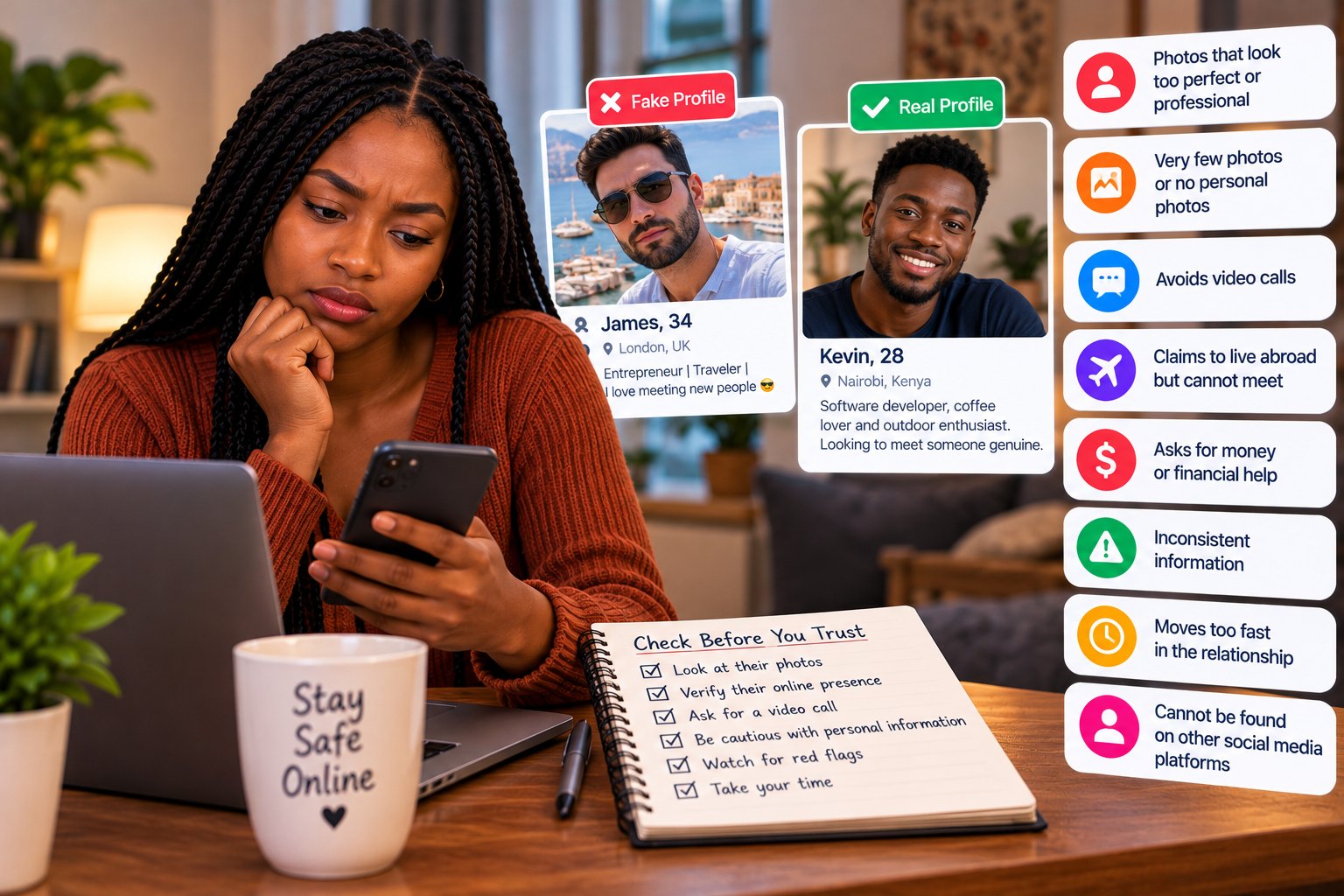
- Too perfect. Every picture looks like a magazine shoot or professional modelling photo, with no ordinary snapshots.
- Only one or two photos. Real people usually have a mix of photos from different places and times.
- No group or casual pictures. Genuine profiles often include friends, events and everyday moments.
- Different looks in each photo. The person seems to change age, face shape or style between pictures.
- Odd details. Strange hands, blurry backgrounds that do not make sense, or a watermark from another website.
- Photos that do not match the story. They say they live in Eldoret, but every photo is in a snowy city.
A reverse image search can help. You save one of their photos and search for it using a search engine's image tool. If the picture appears on other sites under other names, you have your answer.
Bio and profile warning signs
The written parts of a profile can tell you a lot. Read the bio slowly and ask yourself whether it sounds like a real person.
Fake profiles often have a very short bio, or one that is written to appeal to everyone, full of phrases like "God-fearing, loving, honest, caring man looking for a serious relationship." They may list a high-status job that is hard to check, such as an engineer on an offshore rig, a doctor with an international organisation or a soldier on a peace mission. These professions are not impossible, but they are popular choices for people telling stories.
Also look at consistency. Does the age match the photos? Does the location match what they say in chat? Does the job they mention fit the way they write and the hours they message? If the details drift from one day to the next, take notice.
Behaviour that gives a fake away
Often it is how someone acts that tells you the truth, more than what the profile says.
- They move too fast. They say "I love you" or "you are my soulmate" within days, before you have even spoken properly.
- They avoid video calls. There is always a reason: a broken camera, poor network, a work restriction.
- They want to leave the platform quickly. They push you to move to a private chat before they have earned your trust.
- Their answers are vague. Simple questions about their day or their town get general replies or sudden changes of subject.
- They can never meet. Plans keep falling through at the last minute, always for a dramatic reason.
- They ask for money or favours. This can be airtime, M-Pesa, a gift card, help with a fee or an urgent loan.
Any one of these can happen with an honest person. A shy person may avoid cameras. A busy person may cancel. But when several appear together, treat it as a red flag, and do not feel rude for asking questions.
Simple checks you can do yourself
You do not need special tools. Here are practical checks that take a few minutes.
- Ask for a short video call. It is the strongest check there is. A real person can usually manage five minutes.
- Look for a verified badge. On ConnectHub, a verified badge means the person has completed an extra check. It is a useful sign, but still use your own judgement.
- Try a reverse image search. Use two or three of their photos.
- Check their social profiles. A real person usually has some history, such as old posts, tagged photos and friends who comment. A brand new account with few followers is worth a question.
- Ask small, specific questions. Where is the best mandazi near your place? What is the traffic like on your road today? Real answers come easily.
- Compare stories over time. Write down key facts, such as their job and town, and see whether they stay the same.
We have a longer walk-through in how to verify someone is real before meeting, and a short read on why profile verification matters.
What to do if you suspect a fake
If something feels wrong, you do not need proof before you act. Here is a calm way to respond.
- Stop sharing personal details such as your address, workplace, ID details or family information.
- Never send money, airtime or gift cards, however good the story is.
- Take screenshots of the profile and key messages.
- Ask politely for a live video call. You might say: "I would love to see you on video this week. Are you free on Saturday?"
- If they refuse or become angry, block them and report the profile to the platform.
Our guide on how to block and report someone online covers the steps in more detail.
If you have been fooled, it is not your fault
Many sensible, kind people have been caught by fake profiles. These deceptions are built by people who put effort into being convincing, and they work because they use warmth, attention and patience. Feeling embarrassed is natural, but you have done nothing wrong by trusting someone. The person who lied is responsible for the lie.
If you have shared private details or sent money, stop contact, keep every message and screenshot, and contact your bank or mobile money provider quickly. You can also report to the Directorate of Criminal Investigations (DCI). If you feel in danger at any point, call 999 or 112. Talking to a trusted friend can also help you feel less alone with it.
Staying careful and still being open
The aim is not to become suspicious of everyone. It is to be curious, ask questions, and let trust grow at the speed that real evidence supports. A genuine person will be happy to chat on video, answer questions and take things at a steady pace.
You can read more on staying safe on our safety tips page, then browse profiles near you with confidence, or sign up free to start meeting real people.